Profiling

Mapping your inner workings during a sports exercise test

It all starts with understanding your context and goals: that's what shapes the exercise-test protocol, which measures how your body transforms and manages energy. But measurement is only the starting point: the raw data is then processed and analysed with the most appropriate techniques, in line with the current state of the art. Twin Peak Lab also draws on models of muscle energy metabolism to enrich the profile. It's this full process that reveals your physiological and metabolic ID card — your unique signature.

Explore our options

Options & pricing

Build your profile. Reach your summit.

Physiological and metabolic profiling comes in several depths, depending on your goals and your needs. You add the dimensions that matter to you.

The prices below are individual prices, for a one-off test. Two cases lead to a price built to measure:

  • A group. The per-person rate depends on the size of the group: tell us how many of you there are.
  • Monitoring over time. Several tests spread out, to measure a change rather than a snapshot.

The two can go together — a group followed across a season, for instance.

Describe your situation and Twin Peak Lab comes back with a costed proposal.

01

The common path

BASECAMP

Ideal for structuring your training

125 €

Group or monitoring: bespoke pricing

Choose
More info
Individualised thresholds & zones power or speed · HR · % max HR

A progressive exercise test, built around your sport, your goals and your own characteristics. Your individualised thresholds, transitions and training zones are given as power (watts) on the bike, or as pace and speed when running, as well as heart rate.

PEAK

Ideal for structuring your training, measuring your aerobic ceiling and fine-tuning your very-high-intensity sessions

160 €+35 €

Group or monitoring: bespoke pricing

Choose
More info
Individualised thresholds & zones power or speed · HR · % max HR

A progressive exercise test, built around your sport, your goals and your own characteristics. Your individualised thresholds, transitions and training zones are given as power (watts) on the bike, or as pace and speed when running, as well as heart rate.

VO2max · MAS or MAP VO2 at individualised thresholds · % VO2max

We measure VO2max and determine MAS (Maximal Aerobic Speed) for running or MAP (Maximal Aerobic Power, in watts) for cycling. Your thresholds are then also placed relative to your VO2max.

02

Your choice, from PEAK onwards

PEAK + FUEL

Adding FUEL is ideal for understanding your energy metabolism and building your nutrition strategies

195 €+35 € on PEAK

Group or monitoring: bespoke pricing

Choose
More info
Individualised thresholds & zones power or speed · HR · % max HR

A progressive exercise test, built around your sport, your goals and your own characteristics. Your individualised thresholds, transitions and training zones are given as power (watts) on the bike, or as pace and speed when running, as well as heart rate.

VO2max · MAS or MAP VO2 at individualised thresholds · % VO2max

We measure VO2max and determine MAS (Maximal Aerobic Speed) for running or MAP (Maximal Aerobic Power, in watts) for cycling. Your thresholds are then also placed relative to your VO2max.

Energy metabolism kcal/h · carbohydrate–fat mix · g/h

At targeted intensities and within the validity conditions of indirect calorimetry, we establish how much energy you expend, how your fuel mix splits between carbohydrates and fat, and at what oxidation rates — in grams per hour — your body actually uses them.

PEAK + FLOW

Adding FLOW is ideal for measuring your economy and your gross efficiency (cycling)

195 €+35 € on PEAK

Group or monitoring: bespoke pricing

Choose
More info
Individualised thresholds & zones power or speed · HR · % max HR

A progressive exercise test, built around your sport, your goals and your own characteristics. Your individualised thresholds, transitions and training zones are given as power (watts) on the bike, or as pace and speed when running, as well as heart rate.

VO2max · MAS or MAP VO2 at individualised thresholds · % VO2max

We measure VO2max and determine MAS (Maximal Aerobic Speed) for running or MAP (Maximal Aerobic Power, in watts) for cycling. Your thresholds are then also placed relative to your VO2max.

Economy & efficiency O2 cost · efficiency

Your economy is read from your O2 cost: under comparable conditions, a lower oxygen uptake for the same speed or power reflects better economy. Gross efficiency (cycling) quantifies the proportion of metabolic power converted into external mechanical power (what comes out as movement; the rest is lost as heat).

SUMMIT

Ideal for 360° physiological and metabolic profiling

210 €instead of 230 €, that is 20 € less

Group or monitoring: bespoke pricing

Choose
More info
Individualised thresholds & zones power or speed · HR · % max HR

A progressive exercise test, built around your sport, your goals and your own characteristics. Your individualised thresholds, transitions and training zones are given as power (watts) on the bike, or as pace and speed when running, as well as heart rate.

VO2max · MAS or MAP VO2 at individualised thresholds · % VO2max

We measure VO2max and determine MAS (Maximal Aerobic Speed) for running or MAP (Maximal Aerobic Power, in watts) for cycling. Your thresholds are then also placed relative to your VO2max.

Energy metabolism kcal/h · carbohydrate–fat mix · g/h

At targeted intensities and within the validity conditions of indirect calorimetry, we establish how much energy you expend, how your fuel mix splits between carbohydrates and fat, and at what oxidation rates — in grams per hour — your body actually uses them.

Economy & efficiency O2 cost · efficiency

Your economy is read from your O2 cost: under comparable conditions, a lower oxygen uptake for the same speed or power reflects better economy. Gross efficiency (cycling) quantifies the proportion of metabolic power converted into external mechanical power (what comes out as movement; the rest is lost as heat).

The sweat testNew

Precision Fuel & Hydration

Twin Peak Lab is a Precision Fuel & Hydration Authorised Sweat Test Centre

Find us on the official test centre map
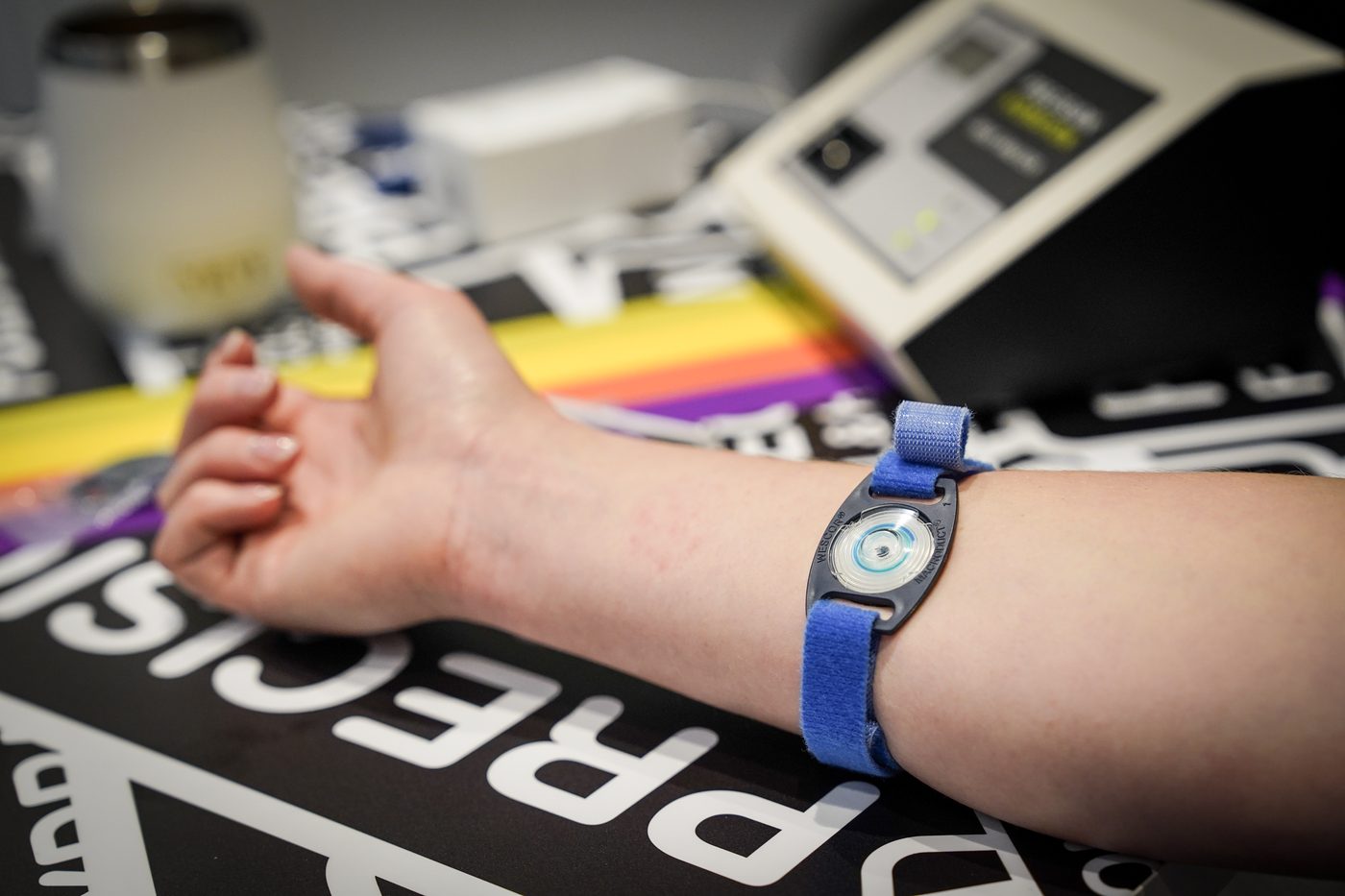
Sweat collector strapped to an athlete's forearm during a sweat test, in front of the analyser.
Photo: Precision Fuel & Hydration
More info

Complete your profiling with your sodium losses

Profiling tells you how your body produces and manages energy. The sweat test adds what you lose through sweating. Sweat carries several electrolytes — mostly sodium and chloride, far more than potassium or magnesium — and your sodium (Na+) concentration is what the analysis returns: among them, it is the one that weighs most on how water is distributed in the body and on how much of what you drink you actually keep.

Two measurements make up the test, and both are specific to you. The sodium concentration of your sweat depends mainly on who you are: it is very stable over time and does not shift with conditions, so a single test is enough. Your sweat rate — how much you sweat per hour — is specific to you as well, but it varies from one session to the next, with the intensity of the effort and the conditions: temperature, humidity, indoors or outdoors. Crossed together, they give your sodium loss in milligrams per hour: enough to know how much electrolyte to take, and when, instead of following a general rule that does not match how your own body works.

You can reach the start line with a perfectly prepared engine and lose your race on this ground alone: it is the component that training does least for, and the one that is put right fastest once you know it.

The test is done at rest, seated and relaxed: sweating is stimulated on the forearm, then the sample is collected. No needle, no exercise, no pain — and no waiting for a laboratory, the analysis is done on the spot: at your home, at your club, or at a partner centre.

The technology comes from medicine. The very same process — stimulating the sweat glands of the forearm by pilocarpine iontophoresis, collecting a few microlitres of sweat, analysing them — has long been used in hospitals, under the name sweat test, to screen for cystic fibrosis. What differs here is the purpose: we derive your sodium concentration in order to build your hydration strategy. No diagnosis, no screening — this is a performance measurement.

The concentration200 to 2,000 mg/Lof sodium per litre of sweat: that is the spread observed from one athlete to another — it is their signature.

The lossup to 15 ×difference, again from one athlete to another, in the sodium actually lost. It depends on two things: the concentration, specific to each person, and the sweat rate, specific to each person too but which also varies with the conditions.

Specific needs

A particular need or a specific project?

These options cover the most common individual requests. For a particular protocol or a different analysis, we go further: we look at the most appropriate measurement systems with you and can build bespoke tools — specific data analyses, group analyses. The proposal and pricing are then built around your needs and your context.

Tell us about your project

How it works

Profiling, step by step

From your context and goals to your physiological and metabolic ID card. The testing, the science and the deliverable are one coherent process — which then carries on, seamlessly, into the application.

1
Upstream

Your context & your goal

You tell us your discipline, your context and what you're looking for. That's what shapes the protocol: tailor-made, focused on what we actually want to measure — never a one-size-fits-all test.

2
The testing

The exercise test

Running the appropriate protocol — blood lactate and/or gas exchange — under standardised, rigorous conditions. This is where your raw measurements are collected. Allow around 1 hr of protocol for BASECAMP and 1 hr 30 for the other profiling options.

3
The science

Analysis & modelling

Your raw measurements are analysed with recognised scientific methodologies and analysis tools developed by Twin Peak Lab. This is the step that turns data into meaning — your individualised thresholds and zones and, depending on the option chosen, VO2max, MAS (Maximal Aerobic Speed) or MAP (Maximal Aerobic Power), your energy metabolism, your economy and your gross efficiency (cycling) — from your own data, never from population averages.

4
The deliverable

Your physiological and metabolic ID card

We hand back your physiological and metabolic signature, with the depth that comes with the option chosen. Your results are presented in detail and discussed with you so they are directly actionable. This is the culmination of profiling.

The integration

And then: the application

Your ID card doesn't stay on paper. It feeds straight into the Twin Peak Lab application, where you explore and use it day to day to calibrate your sessions and track your progress. Profiling and application are one integrated whole.

Discover the application →

The measurements

Three main types of measurements

Profiling rests on three main types of measurements: blood lactate, gas exchange and sweating. Depending on what you want to measure and estimate, we use one of them, or several combined, with the right protocol.

Blood lactate

We measure how your blood lactate concentration changes at key moments — and your heart rate continuously — during a progressive step exercise test, commonly called a lactate test, always tailored to your own characteristics and to your sport, whatever it is: cycling, running, trail running, triathlon, Hyrox, team sports (football, basketball…). The result: the individual identification of your lactate thresholds, your transitions and your training zones.

Gas exchange

We continuously measure, breath by breath, the oxygen (O2) you take in and the carbon dioxide (CO2) you breathe out — along with your heart rate. This gas exchange measurement is commonly called a VO2max test. It is carried out during a progressive exercise test built on an innovative protocol, unique to Twin Peak Lab, that includes a ramp and specific steps, always tailored to your own characteristics and to your sport, whatever it is: cycling, running, trail running, triathlon, Hyrox, team sports (football, basketball…). The result: the individual identification of your ventilatory thresholds, your transitions and your training zones, your VO2max and MAS or MAP, your energy metabolism, your economy (O2 cost) and your gross efficiency (cycling).

Sweating and sodium

A sweat test combines two measurements, and both are yours alone. Your sweat sodium concentration is measured at rest, seated and relaxed, with no effort and no needle: we stimulate sweating on the forearm, collect a few microlitres, and the analysis is done on the spot. Very stable over time, it only needs one test. Your sweat rate is established from your own sessions and in different conditions, because it varies with exercise intensity, temperature and humidity: you get the method and the sheet to fill in, and we do the calculation. The result: your sodium concentration in mg/L, your sweat rate in L/h and, combined, your sodium loss in mg/h — a hydration strategy built on your own losses rather than on a general rule.

A bespoke protocol, not a one-size-fits-all test. The progressive exercise-test protocol is built around what we set out to measure. Some centres measure everything with a single protocol — but it is well established that, done this way, certain parameters are not estimated correctly. Twin Peak Lab works with the utmost scientific rigour: that's why we will never offer you a single test meant to measure everything at once — it makes no sense. Depending on your needs and goals, we adopt the most suitable solution.
In the field

Measuring in your real conditions, on the bike or on foot depending on your sport

To us, a measurement only matters if it's usable day to day. Benchmarks captured in conditions you never meet in training are of limited use: what counts is information that's reproducible, day after day, in your real context.

That's why we work mobile, in Liège and across the Liège region: at your home, at your club, or more generally wherever you train. The protocol adapts to your sport and to what you have: on the bike, on your home trainer; on foot, on your treadmill or on the track. The test then takes place in the very environment of your training: whether you're an athlete, coach, club, structure or federation, we measure where you make progress every day.

Don't have the right equipment? The test can also be carried out at one of our partner centres. At your venue or at a partner centre, we work across Belgium and Luxembourg; beyond that, travel is arranged on request.

The deliverable

Your physiological and metabolic ID card

At the end of the test, you leave with far more than a single number:

  • Your individualised thresholds and training zones
  • Depending on the option chosen: VO2max and MAS or MAP, a reading of your energy metabolism, your economy (O2 cost) and your gross efficiency (cycling)
  • Concrete benchmarks to calibrate your training
  • Access to the app to explore and track your results

Book your profiling

A few details are all it takes to get started.

Book your profiling