Exercise physiology
Energy systems: the myth of pathways that take turns
Why the three pathways work together, from the very first second
We are often taught that the energy of effort arrives in three stages: first phosphocreatine for a few seconds, then glycolysis (the so-called “anaerobic” system) for one to two minutes, and finally the aerobic system, which supposedly takes over only for long efforts. This picture is wrong. From the very first second, all three pathways run at the same time. What changes with duration and intensity is not “which one is switched on”, but their proportion in the mix.
It is one of the most widespread diagrams in gyms and textbooks: three energy “systems” that follow one another like relay runners, each handing the baton to the next. Simple, visual, easy to remember. The trouble is that real measurements show nothing of the sort.
Common misconceptions
The classic picture: three pathways in single file
The usual story fits in one sentence: the muscle would first use phosphocreatine for a few seconds, then glycolysis, then only the aerobic system for efforts that last. The first two pathways need no oxygen: these are the so-called “anaerobic” systems (phosphocreatine without lactate, glycolysis with it); the third is the “aerobic” one. Three misconceptions follow from this.
Misconception The systems switch on one after another
No system waits its turn. From the very first contraction, phosphocreatine, glycolysis and the aerobic system all supply energy. Only their relative share changes.
Misconception The aerobic system is useless for short efforts
The aerobic system contributes from the first seconds, and its share climbs very fast.
Misconception The anaerobic systems play no role in long efforts
Even when the aerobic system becomes dominant, glycolysis keeps running: it does not switch off.
Before the graphs, four words to set down, without needless jargon:
ATP (adenosine triphosphate): the energy “currency” of the cell. The muscle holds only very small reserves, so it must remake it continuously during effort.
Phosphocreatine: a reserve that rebuilds ATP almost instantly, but which runs out within a few tens of seconds.
Glycolysis: the rapid breakdown of sugar (glucose or glycogen) down to pyruvate, in the cell's cytosol. It remakes ATP very fast, without needing oxygen for this first step.
Aerobic system: the pathway that remakes ATP in the mitochondria by consuming oxygen. It takes longer to reach full rate, but its capacity is almost inexhaustible.
The Gastin & Suppiah study (2026)
The three systems run at the same time, not one after another
Gastin and Suppiah [1] provide a measured illustration. Their figure tracks, in a well-trained triathlete, the share supplied by each of the three pathways at every second, across two maximal efforts: a 90-second all-out effort (flat out from start to finish, panel A) and a constant-intensity effort set at 110% of his maximal oxygen uptake, held to exhaustion (panel B). The dashed curve is the energy demand: the rate of energy the effort calls for at each instant, expressed in oxygen equivalent (the unit of the vertical axis). It reflects the power produced, of which it is the energy cost.
How is this energy split between the three pathways? The aerobic share is read from the oxygen consumed during the effort. The anaerobic share, lacking a direct measurement, is trickier: here the article relies on the oxygen deficit, an indirect method. First, at moderate intensities, the relationship between power and oxygen consumed is established; it is then extended up to the effort's intensity to estimate the oxygen it should cost; the gap with the oxygen actually consumed gives an estimate of anaerobic energy. The authors do point out the limits of this approach, which rests on an extrapolation.
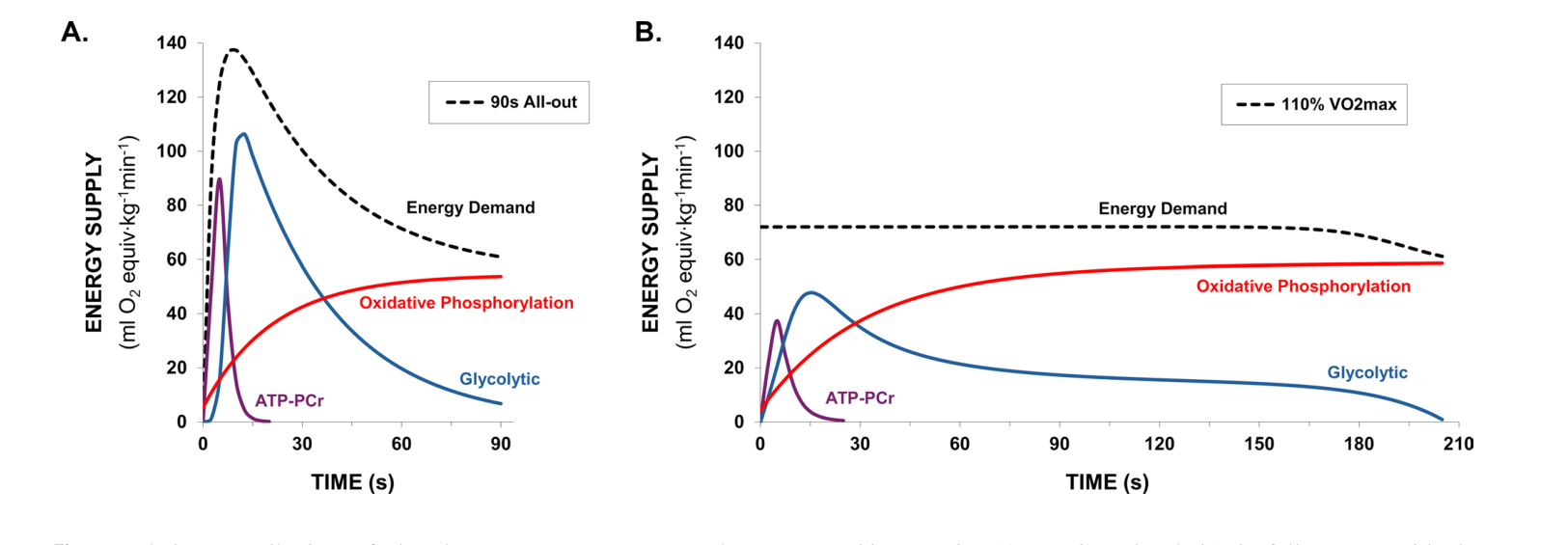
One detail of these curves deserves a word, because it is telling: the energy demand (the dashed line) is not flat. In the all-out sprint (A), it starts very high then falls without stopping, because the power produced drops as the anaerobic reserves run down. In the constant-intensity effort (B), it stays stable, then plunges at the very end. The reason is instructive: at that precise moment, the anaerobic capacity (phosphocreatine plus glycolysis) is exhausted. The muscle can then produce no more than the power supplied by the aerobic system alone, and the demand falls back to the level of the red curve (the oxidative one). This is, at bottom, what you feel when you “crack” at the end of an effort: the anaerobic tank is empty, and you find yourself capped at aerobic power.
The mechanism
Why the three pathways necessarily start together
The starting point is not an opinion, it is a physical constraint. The muscle stores almost no ATP, on the order of 8 mmol per kilo. Yet demand can be multiplied by 100, even by 1000, going from rest to intense effort. Hargreaves and Spriet [2] put numbers on it with an example: at the intensity of an all-out sprint (in their example, about 900 watts, close to three times the power that brings you to maximal oxygen uptake), the ATP store on its own would be exhausted in less than 2 seconds; even at moderate intensity (about 75% of that maximal uptake), it would last only some fifteen seconds. These values depend on the individual and the intensity, but the order of magnitude is clear: the muscle must remake its ATP continuously.
You can see this in the figure by Baker and colleagues [3]: a representation, established from measurements, of how ATP and its reserves change in the muscle during an intense effort. Panel by panel, over 3 minutes carried to exhaustion, it tracks the rate of ATP renewal (panel a, ATP turnover), phosphocreatine (b, creatine phosphate), inorganic phosphate (c, inorganic phosphate, a product of ATP breakdown) and ATP itself (d). This last one stays remarkably preserved for almost the entire effort.
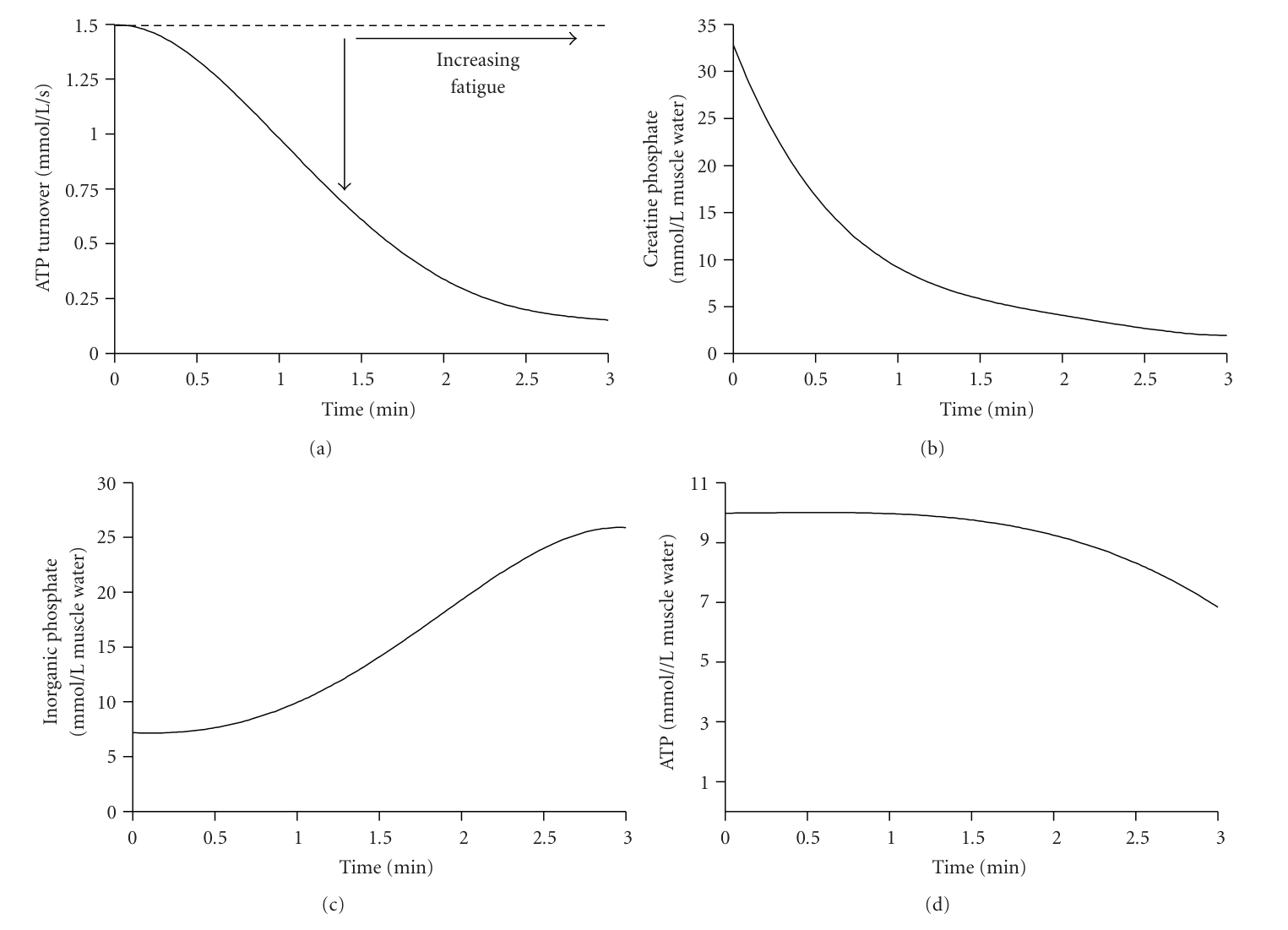
This behaviour is established by two direct measurement methods, cross-checked across many studies. The muscle biopsy: a fragment of muscle is taken before and just after the effort, and ATP, phosphocreatine and the products of glycolysis are assayed. Phosphorus magnetic resonance spectroscopy: an instrument that tracks, live and without sampling, phosphocreatine and ATP in the working muscle, second by second.
This stability of ATP, clearly visible in the figure (panel d), is the fruit of joint work: the muscle must remake ATP without waiting, and the first figure already showed it, the three pathways rise together from the start, each at its own speed.
This is also the whole point of the review by Baker and colleagues [3]: to re-explain the simultaneous and coordinated contributions of the energy systems. They recall in passing a historical correction: it was long believed that, during the first 10 to 15 seconds, phosphocreatine was solely responsible for regenerating ATP. Modern measurements show that glycolysis is activated rapidly, from the very start of intense effort.
How, then, should we picture these three pathways without falling back into the relay myth? By describing them by what they are, not by when they would act. They all respond to the same signal: from the first contraction, the breakdown of ATP and the release of calcium raise ADP and AMP (adenosine diphosphate and adenosine monophosphate, what ATP becomes when it gives up one or two of its three phosphates to release energy), along with inorganic phosphate, and this common signal activates them in parallel. There are not three triggers that follow one another, but a single, shared one.
What really sets them apart comes down to two stable properties: their power (the rate at which they supply ATP) and their capacity (the total amount before exhaustion). It is this combination, and not an order of play, that explains why phosphocreatine weighs heavily from the outset, why glycolysis carries efforts of a few tens of seconds, and why the aerobic system ends up covering everything once the effort lasts.
You can then lean on images to picture it: a pool of ATP kept almost full by three taps of different flow and reserve, or two power/capacity axes on which to place each pathway. These are only mental aids, and one may prefer another. What matters is that none should reintroduce the false idea of a relay, because the real functioning does not change: three pathways active together, triggered by the same signal, whose proportions readjust continuously with intensity and duration.
Conclusion
A shifting mix, not a relay
The image of three pathways passing the baton is handy for a first lesson, but it fosters two stubborn errors: believing that the aerobic system sleeps during short efforts, and believing that the anaerobic systems switch off as soon as the aerobic one rises. Measurements inside the muscle say the opposite.
The three energy systems do not switch on one after another. From the very first second, phosphocreatine, glycolysis and the aerobic system all supply energy at the same time, because the muscle stores almost no ATP and must maintain it through every pathway at once. What changes with duration and intensity is their proportion in the mix. The aerobic system is neither slow nor idle at the start of an effort; the anaerobic systems do not switch off when the aerobic one dominates. In other words, the energy of effort is not a relay: it is a mix that readjusts continuously.
Key takeaways
- The three energy pathways run at the same time, from the very first second.
- A single signal triggers them all together: there is no relay.
- The muscle stores very little ATP (exhausted in less than 2 seconds in a sprint): the three pathways must therefore start together.
- What changes with duration is their proportion in the mix, not their switching on.
Arnaud Collet, PhD, CPSS®
References (3)
[1] P. B. Gastin, H. T. Suppiah, “Anaerobic and Aerobic Energy System Contribution During Maximal Exercise: A Systematic Review”, Sports Med, 2026.
[2] M. Hargreaves, L. L. Spriet, “Skeletal Muscle Energy Metabolism During Exercise”, Nat Metab, 2020.
[3] J. S. Baker, M. C. McCormick, R. A. Robergs, “Interaction Among Skeletal Muscle Metabolic Energy Systems During Intense Exercise”, J Nutr Metab, 2010.