Metabolism
Lactate, the phoenix of metabolism: why we should stop saying waste product, lactic acid and anaerobic threshold
What George A. Brooks's work really changes
Lactate is not the waste product of a muscle starved of oxygen. It is a central metabolic molecule, produced continuously, exchanged between cells, used as fuel, recycled into glucose and involved in adaptation signalling. What we still too often call the “anaerobic threshold” does not mark an abrupt switch to an oxygen-free mode, but a change in the balance between the appearance and disappearance of lactate. In other words, lactate does not signal the system's failure: it reveals its dynamics.
For decades, lactate has been cast as the symbol of effort gone wrong: a waste product, a metabolic poison, an agent of fatigue, even the sign that a muscle had “gone anaerobic”. Yet the work of George A. Brooks forces us to change that reading completely.
His thinking comes together across three papers. In “Lactate in contemporary biology: a phoenix risen” [1], Brooks argues that lactate must be rehabilitated: it rises like a phoenix after a century of misinterpretation. In “The Science and Translation of Lactate Shuttle Theory” [2], he sets out the central mechanism: the lactate shuttle. In “The ‘Anaerobic Threshold’ Concept Is Not Valid in Physiology and Medicine” [3], he explains why the notion of an “anaerobic threshold” is physiologically problematic.
The problem is not only scientific. It is also lexical. The words we use — “waste product”, “lactic acid”, “anaerobic” — shape how we understand effort. And in Brooks's work, those words often lead to the wrong conclusions.
Part 1
The received ideas to take apart
Received idea Lactate is a waste product
Brooks rejects this view. Lactate is a major metabolic intermediate. It is at once an energy substrate, a major precursor for gluconeogenesis (the making of glucose) and a signalling molecule.
Lactate is not a metabolic dead end. It is a mobile form of carbon-based energy, able to circulate between cells and organs.
Received idea Lactate appears when oxygen runs short
This is a false simplification. Brooks stresses that lactate is produced continuously, even under fully aerobic conditions.
That does not mean hypoxia or certain pathological situations cannot influence blood lactate. But in exercise and in normal physiology, the presence of lactate cannot automatically be read as proof of a lack of oxygen.
Lactate does not mean “absence of oxygen”. It means, first of all, that there is glycolytic flux — production, transport and use of lactate.
Received idea Lactate is responsible for the muscle burn
Careful not to swing from one caricature to the other: lactate and acidosis are not unrelated. During intense effort, lactate and acid–base disturbances often appear together, but lactate must not be reduced to “the acid that burns the muscle”. Brooks recalls that acidosis is a complex phenomenon, tied notably to ATP hydrolysis, CO2, buffer systems and ionic balances. Reducing all of that to “lactic acid” confuses a whole procession of phenomena with one of its travelling companions.
Received idea Lactate directly causes fatigue
Fatigue is multifactorial. Lactate often accompanies intense effort, but it is not a simple metabolic poison.
Lactate is more a witness and an actor of an intense metabolic response than an isolated cause of fatigue.
Received idea The anaerobic threshold marks the switch to anaerobic metabolism
This is the heart of the paper “The ‘Anaerobic Threshold’ Concept Is Not Valid in Physiology and Medicine” [3]. Brooks challenges the physiological validity of the concept of an anaerobic threshold. That does not mean throwing everything out: lactate and ventilatory thresholds, or the MLSS (maximal lactate steady state), can be useful as practical tools. What Brooks criticises is the interpretation that these thresholds indicate a clean switch to an oxygen-free metabolism.
The problem is not measuring lactate. The problem is jumping to the conclusion that its rise means a lack of oxygen.
Part 2
Lactate the phoenix: why Brooks speaks of a rebirth
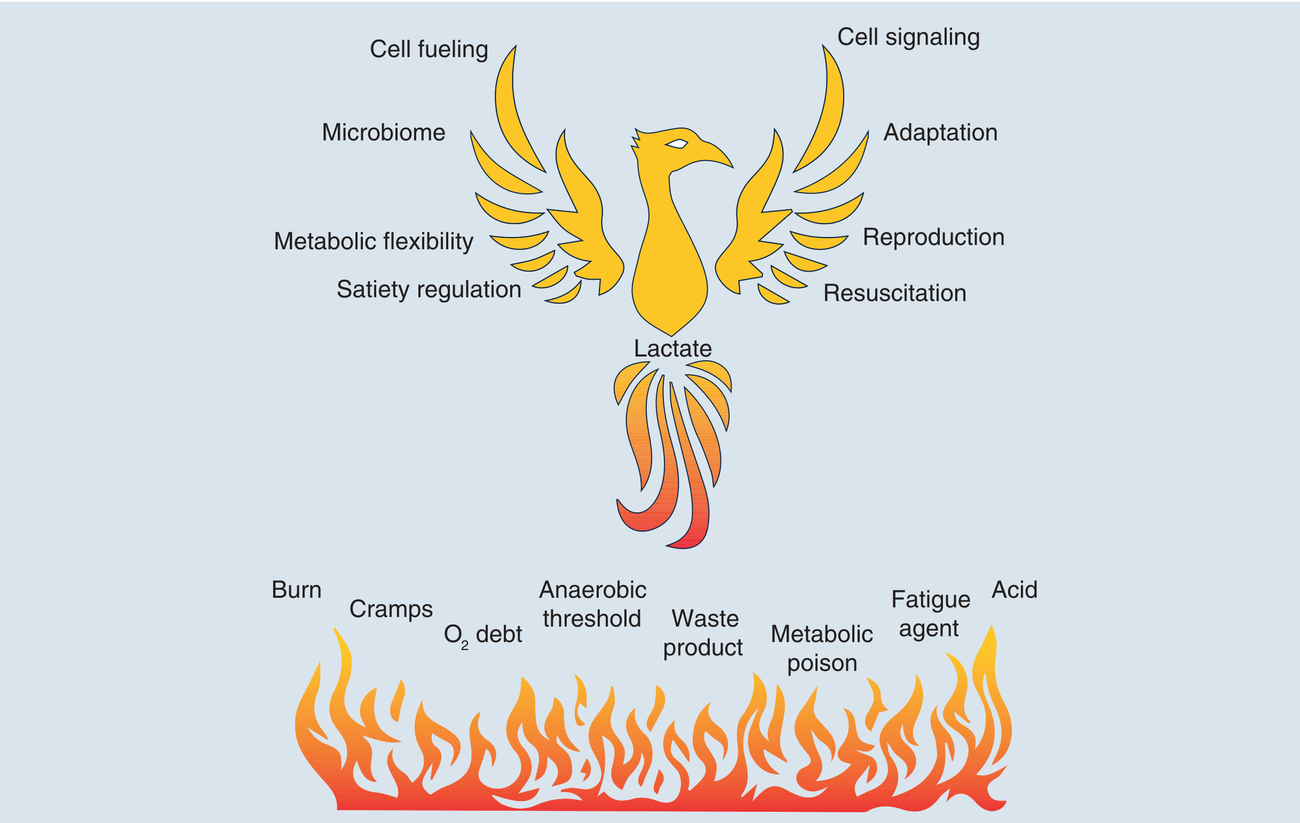
The title of the paper “Lactate in contemporary biology: a phoenix risen” [1] is not mere stylistic flourish. Lactate is a “phoenix” because it is reborn in contemporary biology after decades tied to negative ideas: waste product, poison, acidosis, fatigue, oxygen debt, anaerobic threshold.
In that paper, Brooks and colleagues explain that lactate is now understood as a central molecule across several dimensions: energy production and distribution, cell signalling, adaptation to exercise, metabolic flexibility, brain function, health and disease, and even clinical resuscitation.
Lactate is not an anomaly of intense exercise. It is part of the normal working of metabolism.
In Brooks's work, lactate is no longer the residue of an imperfect metabolism. It becomes a molecule of integration: it links energy pathways, cells and organs.
Part 3
The lactate shuttle: the key to understanding
The paper “The Science and Translation of Lactate Shuttle Theory” [2] sets out the central mechanism. The principle is simple to state: some cells or fibres produce more lactate; others can take it up and use it. Lactate therefore circulates between producer cells and consumer cells.
This transport is anything but passive. It runs through dedicated membrane transporters (the MCTs, monocarboxylate transporters) and involves a well-identified chain: production, transport, uptake, oxidation, gluconeogenesis and signalling. These exchanges occur at every scale:
- between glycolytic muscle fibres and more oxidative fibres;
- from active muscle to the heart;
- from active muscle to the brain;
- from muscle to the liver and kidneys, for gluconeogenesis;
- between astrocytes and neurons, within the brain itself.
One point deserves emphasis, because it is often distorted: not all lactate ends up in the liver. The oxidation of lactate — its direct use as fuel — in active muscles, the heart and other tissues is at least as important as its recycling into glucose.
Lactate is a shuttle between glycolysis and mitochondrial respiration. It lets one part of the system quickly produce a substrate, and another part use it as fuel.
You can sum it up in an image: lactate is a metabolic currency. But the image only holds if we always come back to the concrete mechanism — production, transport, uptake, oxidation, recycling.
Part 4
Blood lactate: a concentration doesn't tell the whole story
Here is an essential and often counter-intuitive point: a blood lactate concentration does not directly tell you the turnover of lactate — the rate at which it is actually produced and consumed.
Two quantities matter:
- Ra (rate of appearance), the rate at which lactate appears in the blood;
- Rd (rate of disappearance), the rate at which lactate is removed, or cleared.
Blood lactate rises when Ra exceeds Rd. That can come from increased production, from a relative fall in clearance, or from an imbalance between the two. The same number on the meter can therefore cover different metabolic situations.
This matters directly for training. A trained athlete may show a lower blood lactate at a given intensity not only because they potentially produce less lactate, but also because they are better at taking it up, oxidising it and recycling it. The number has dropped; the reason is not a single one.
A blood lactate value is not a direct measure of glycolytic production. It is the net result of production, cellular efflux, transport, uptake, oxidation, gluconeogenesis and distribution.
Part 5
Why anaerobic threshold is a problematic term
The title of the paper — “The ‘Anaerobic Threshold’ Concept Is Not Valid in Physiology and Medicine” [3] — is deliberately strong. It still has to be read correctly.
Brooks does not say that we should stop measuring lactate, nor that intensity transitions don't exist, nor that the MLSS or practical thresholds are useless.
Brooks says that the word “anaerobic” is misleading; that a rise in lactate does not automatically prove a lack of oxygen; that lactate is produced continuously under aerobic conditions; and that blood lactate mainly reflects the balance between the appearance and disappearance of lactate.
The lactate threshold is a tool. The “anaerobic threshold”, understood as an abrupt switch to an oxygen-free metabolism, is a misinterpretation.
Several more rigorous formulations exist depending on context: lactate threshold, lactate transition, maximal lactate steady state (MLSS), moderate / heavy / severe intensity domains, lactate production–clearance balance, or lactate dynamics.
Let's be fair: “anaerobic threshold” is still sometimes used in the literature and in everyday language. The term isn't forbidden — it is physiologically ambiguous, and that ambiguity is what to keep in mind.
Part 6
What this changes for testing and training
Measuring lactate remains very valuable. What changes is how we interpret the measurement.
- Lactate helps identify intensity transitions.
- It informs on the overall metabolic response to an effort.
- It should not be read as a simple marker of a lack of oxygen.
- You have to account for step duration, steady state, clearance and temporal dynamics.
- Avoid overly short protocols if you want to read lactate values as representative of a given intensity.
The question is not only “how much lactate is produced?”, but “how fast does lactate appear, disappear, circulate, get oxidised or recycled?”
Part 7
The words to change
| Phrase to avoid | More rigorous phrasing |
|---|---|
| “Lactic acid” | “Lactate”, except in a precise chemical context |
| “Lactate is a waste product” | “Lactate is an energy substrate, a metabolic intermediate and a signalling molecule” |
| “Lactate causes fatigue” | “Fatigue is multifactorial; lactate accompanies intense effort without being a simple metabolic poison” |
| “The muscle goes anaerobic” | “Glycolytic contribution rises and the lactate production/clearance balance shifts” |
| “Lactic acid build-up” | “Rise in blood lactate and associated acid–base disturbances” |
| “Lactate = lack of oxygen” | “Lactate = metabolic flux dynamics, transport, oxidation and signalling” |
Conclusion
Lactate does not signal the system's failure
For a long time, lactate was burned by mistaken interpretations. Brooks's work brings it back to life as a central molecule of contemporary metabolism.
Lactate does not signal the system's failure. On the contrary, it reveals how the system organises itself to produce, redistribute and use energy.
Lactate is not the waste product of a muscle starved of oxygen. It is a central metabolic molecule, produced continuously, exchanged between cells, used as fuel, recycled into glucose and involved in adaptation signalling. What we still too often call the “anaerobic threshold” does not mark an abrupt switch to an oxygen-free mode, but a change in the balance between the appearance and disappearance of lactate. In other words, lactate does not signal the system's failure: it reveals its dynamics.
Key takeaways
- Lactate is not a waste product.
- It is produced continuously, even under aerobic conditions.
- It serves as fuel, a glucose precursor and a cellular signal.
- A high blood lactate reflects an imbalance between the appearance and disappearance of lactate.
- The term “anaerobic threshold” is misleading if read as an abrupt switch to an oxygen-free mode.
Arnaud Collet, PhD, CPSS®
References (3)
[1] G. A. Brooks et al., “Lactate in contemporary biology: a phoenix risen”, J Physiol, 2022.
[2] G. A. Brooks, “The Science and Translation of Lactate Shuttle Theory”, Cell Metab, 2018.
[3] G. A. Brooks, “The ‘Anaerobic Threshold’ Concept Is Not Valid in Physiology and Medicine”, Med Sci Sports Exerc, 2021.